

What is MODARI?
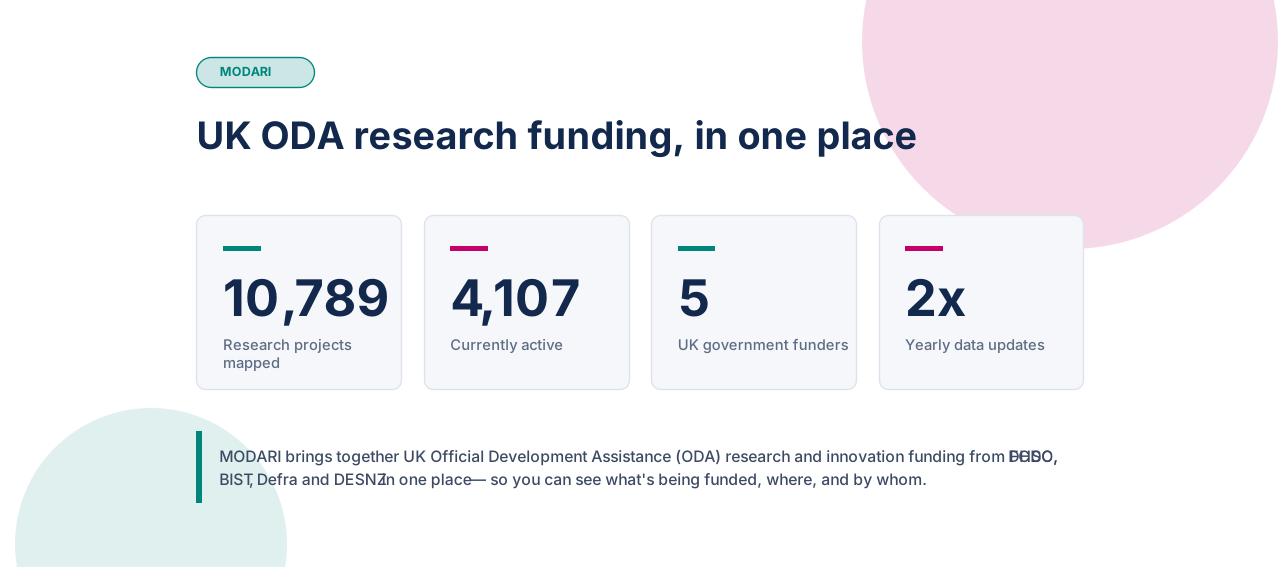
MODARI is a project working to improve the availability and consistency of data on ODA-funded research and innovation across UK government funders and implementing partners. This work began in 2021 and continues today with three areas of focus:
- Mapping UK R&I ODA through several dashboards.
- Explaining the UK R&I ODA landscape by signposting to funders’ websites (click here for an overview).
- Collating results of ODA-funded R&I (work ongoing)
How the data is organised
MODARI draws on two underlying datasets, each suited to different types of analysis. You don’t need to choose between them – the sections below guide you through both – but if you want to understand what sits behind the figures, here’s how they differ:
| Dataset contains | Funding and spend data | Research project data |
|---|---|---|
| Financial Information: actual spend | x | |
| Financial Information: commitments | x | |
| Number of Awards | x | |
| Annual Disbursements | x | |
| 7-year timespan | x | |
| 3-year timespan | x | |
| Organisational Information | x |
Research project data
This dashboard shows the number of projects by funder, theme, benefitting countries, and extending, lead, and partner organisations.
Definitions
- Funder: The UK government department funding the project.
- Extending organisation: The public sector organisation that manages the budget and direction of an activity on behalf of HMG. Not all awards will go through an extending organisation. For MODARI, Wellcome is also considered an extending organisation.
- Lead Organisation: The direct recipient of funding (from the funder or extending organisation).
- Partner organisation: Other recipients of funding with a role in activity delivery. They most commonly receive funding from lead organisations.
- Beneficiary country: A country the research is explicitly benefiting. This may be the location of lead and partner organisations and/or additional countries relevant to the research. Sometimes the location of lead and partner organisations are not benefiting countries.
Data source Data comes from International Aid Transparency Initiative (IATI) and directly from ODA funders, building on their existing IT systems and ODA reporting processes. We collect standardised project information every six months to ensure the MODARI database remains up to date. In addition to standard data fields, we also collect information on the fund, programme, lead and partner organisations, and recipient countries.
Data limitations
- Some FCDO project data is not available at a project level. However, programme information is centrally collected and reported by FCDO. To access programme information, see our Financial Dashboard.
- Many external partners receive funding from multiple organisations for their projects, some of which may be non-UK ODA. This should be considered when totalling UK ODA investment across projects. Projects labelled as belonging to the funds “FCDO Research – Partnerships” and “Global Health Research – Partnerships” are more likely to include non-UK ODA.
- Some data on benefiting countries is missing from reporting. To fill gaps in reporting and provide a more comprehensive view of beneficiary countries, the MODARI tool also includes country names pulled from project titles. This assumes that countries in project titles are likely to benefit from a given ODA project.
- Some names / countries of partner organisations are missing. UK research funding is typically awarded to UK lead institutions who disperse funding to partner organisations, including those based in LMICs. Due to the structure of ODA reporting, those downstream disbursements are not always fully captured.
Themes Projects have been categorised into the following key research themes:
- Agricultural advancements: research and development projects focusing on improving agricultural practices, enhancing crop yields, sustainable farming methods, and technological innovations in the agricultural sector
- Climate change: focused on reducing greenhouse gas emissions, developing policies and strategies to combat climate change, and enhancing carbon sequestration methods
- Education: projects focusing on educational research, access to quality education, and innovations in the education sector
- Energy: initiatives aimed at advancing renewable energy sources, improving energy efficiency, and exploring innovative technologies for clean and sustainable energy production
- Environmental sustainability: projects promoting environmental sustainability, biodiversity conservation, sustainable resource management, and solutions to mitigate the impact of environmental challenges
- Governance and policy: projects related to improving governance structures, policy development, and capacity-building for effective public administration
- Health: projects dedicated to medical advancements, public health research, disease prevention, and the development of healthcare technologies to improve overall health outcomes
- Humanitarian assistance: research and development efforts focused on providing aid and support to communities affected by disasters, conflicts, or emergencies
- Infrastructure development: initiatives aimed at improving and expanding critical infrastructure, including transportation, water supply, and technology networks
- Social equity and protection: projects addressing gender disparities, promoting women’s rights, enhancing social welfare, poverty alleviation, and developing safety nets to protect vulnerable populations
- Violence and conflict mitigation: initiatives focused on understanding, preventing, and mitigating violence and conflict, ranging from conflict resolution strategies to promoting peace-building efforts
Archived datasets Download July 2025 MODARI data here|January 2025|August 2024|January 2024|July 2023|December 2021
Funding and spend data
Data source This data comes from the Statistics on International Development (SID) publication, the official accredited summary of all UK ODA spending. Annual spend data for a given year is typically published in the SID publication during the following April. This dashboard and dataset focus on the subset of the SID data relating to research. Programmes or projects were included when they met one or more of the following conditions: i) were tagged with a research sector code, ii) were part of a research fund, iii) had the word ‘research’ in their title or abstract. UKCDR worked with funding departments to ensure the financial figures are as accurate as possible.
Data limitations
- Timespan: Information from the current year cannot be included because the SID data is published annually after the close of the previous financial year.
- Benefiting country information: Financial information can only be attributed to a country when a programme is single country-specific. When ODA spending is not country specific or benefits more than one country, it is categorised differently. In practice, this means that country-level ODA figures are likely underestimates of the total amount of research and innovation disbursements that benefit a country. For an illustration of how countries are categorised within the SID, see the table below:
| Actual benefiting countries | How the project is categorised in the SID | |
| A | Nigeria | Nigeria |
| B | Nigeria, Kenya | Africa, regional |
| C | Nigeria, Kenya, Colombia | Developing countries, unspecified |
In this dashboard, if you filter the data for Nigeria, the net ODA amount will only include projects like row A.
Download data
You have two options for downloading data:
- Download the full underlying dataset beneath the dashboard – designed for users who want to manipulate the full dataset for their own analyses.
- Download filtered data from within the Tableau toolbar using the Download button (crosstab option) – designed for users who only want a subset of filtered data. Dashboards can be filtered by clicking parts of the visualisations or using the filter dropdown tabs; click the same part again to deselect. Use the search bar to look for keywords in the project title and abstract.
Why is UKCDR working on this?
UKCDR has delivered several analyses on ODA-funded research and innovation. We understand the challenges and opportunities associated with cross-funder datasets perhaps better than any other organisation. We strongly believe that timely, reliable data are key for a coherent, impactful approach to funding development research.